Anki has fundamentally changed how I learn
If there’s one thing I would give the version of me 4 years ago who was just starting to seriously learn from the internet, it’d be Anki.
Memory is a huge part of learning (as the ever-growing LLMs can attest).
I used to spend a lot of effort tracking in a spreadsheet which textbook pages or problems to review, but then never get around to it because it felt more productive to read the next chapter. So after a month, I wouldn’t be able to do the problems I’d spent hours learning.
Now software does it all. Anki schedules flashcards to ensure you remember. After finding Michael Nielson’s and Gwern’s writeups, learning has really never been the same. Please check those out if you haven’t already. Here, I want to share some takeaways I don’t see discussed as much.
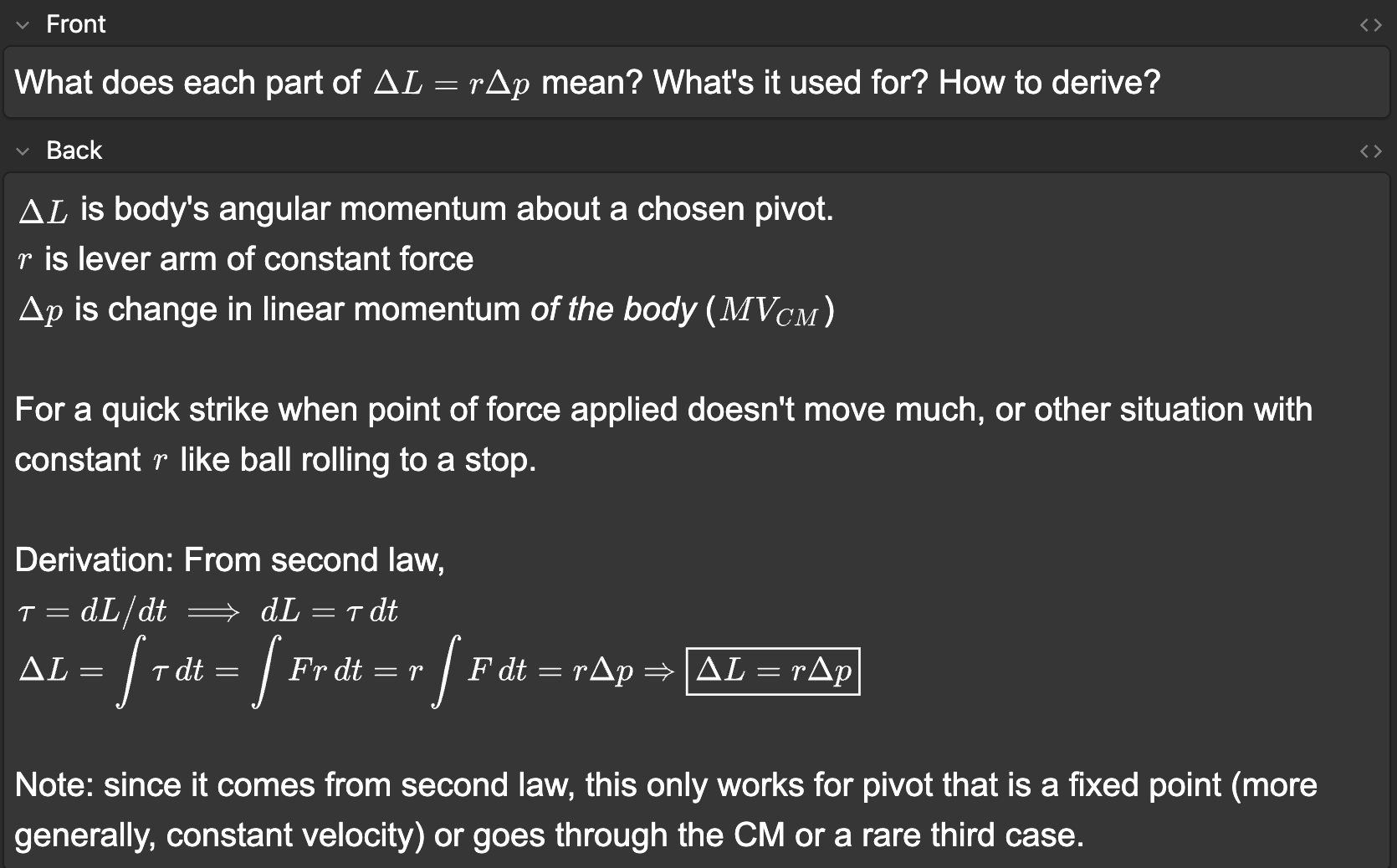
Some things I use Anki to remember:
- Physics textbook concepts
- Data structure/algorithms
- USACO problems (the general arc of a solution, and more importantly how I could have thought of it after reading the problem. also coding tricks. this is a topic for a whole future post)
- Takeaways from important articles, papers, videos, conversations
- Making or changing habits. For instance,
- Front: I notice a bad habit that is new information to me. Back: Think “HA, GOTCHA! Now what’s a better course of action?” This positive emotional valence reinforces the noticing of problems instead of discouraging it.
- (h/t Alexey)
- Basic anatomy like muscle names, so I can pinpoint injuries
- Facts about people to show that I care
- Excerpts of writing I like to rub off into my own language (h/t Michael)
Don’t just study cards in transition
I used to try to finish the daily cards while waiting for the bus and other idle periods. But if Anki doesn’t feel like productive work, I end up rushing through and neglect cards I’m starting to forget. Then the next time I forget even more and lose track of all the cards that need more effort. So now I sit-down every few days to think about which cards need reinforcement and actually make revisions. It’s time well spent. These cards are what shape my lifelong thoughts after all.
Make “cosmic” cards
Michael Nielson advocates for “atomic” cards, where you break up a question into single step recall, so it’s clear if you remembered or not. I thought that made sense and broke apart every derivation into components. I thought if I tied every link A->B and B->C and so on, I’d automatically be able to construct E from A. The problem with atoms is I only barely remember enough to mark “good” but could never actually pull out the information in real situations. I need broader context cards, or cosmic, that become the first thing I recall when a concept is mentioned.
For example:
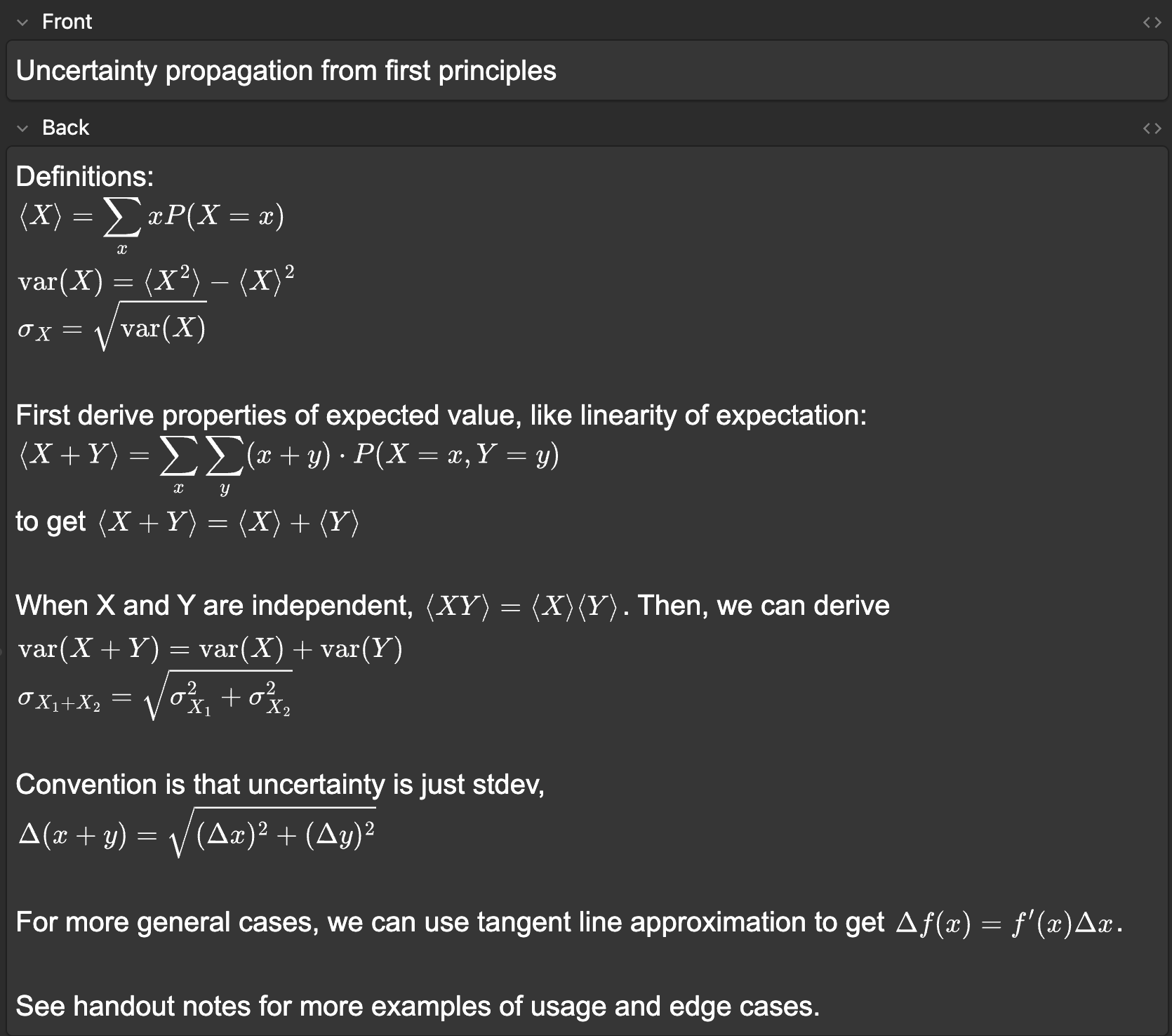
(which really isn’t as bad as it looks because I have more detailed cards for each step.)
Don’t overankify. Let problems apply spaced repetition for you.
While you do want to make many cards to solidify important concepts, you do not want to ankify every concept. Textbooks make you feel like every bit is important and create fear that you’ll forget something used later. But I’ve found this just bloats up Anki for me. I now only take notes while reading and then ankify after doing some of the chapter’s problems.